The older I get, the more I realize and appreciate what my parents and ancestors sacrificed so I could have the life I have. That’s why a recent visit to Ireland with my husband filled me with joy and gratitude.
I’m about 75% Irish descent, with relatives as recent as my paternal grandparents immigrating to America in the early 1900s, as well as my maternal grandmother’s parents emigrating from Ireland to the United States in the late 1800s. While we visited many of the most popular tourist attractions, such as Dublin’s Guinness Storehouse, Blarney Castle, and the Cliffs of Moher, the most memorable moments for me were seeing the counties where my grandparents grew up. I looked around Galway, where my grandmother was raised, especially Galway Bay, and realized just how difficult life must have been for her to leave such a beautiful place. Driving around Offaly, where my grandfather grew up, and seeing the grave site of my grandfather’s parents as well as some of his siblings, I wondered there, too, how terrible it must have been to have left such a quaint place and leave so many family members behind.
Unfortunately, I know little about my family’s time in Ireland as my paternal grandfather died before I was born, and my paternal grandmother passed away shortly before I turned six. My maternal grandmother also didn’t know much about her parents’ experiences, as her mother died when my grandmother was young, and her father’s stories seemed to be more about spotting leprechauns on the way home from the pub.
One of my aunts, who was married to my father’s brother Jimmy, was also from Ireland, but she didn’t really talk about her homeland much. Until one day I told her how I had just finished reading Frank McCourt’s “Angela’s Ashes,” which depicts life in Ireland around the Great Depression and World War II. She told me she had a videotape of the movie, and she would watch it every once in a while. The author grew up in Ireland around the same time as her, and my aunt told me she felt he captured life exactly as it was then. If you have read the book or seen the movie, you know life in Ireland for many wasn’t easy.
During the trip, I learned more about my heritage by visiting two informative museums in Ireland dedicated to emigration to places such as the United States, Canada, and Australia. The first was EPIC The Irish Emigration Museum in Dublin, and the second was Cobh Heritage Center in Cobh in County Cork.
Since I was a teenager, I’ve had some idea of how difficult life once was for people in Ireland through books, movies, and television shows. Still, the more I learn about the obstacles the Irish faced, the more I realize and appreciate the struggles endured and the sacrifices my relatives made to create a better life for themselves and the future generations they dreamed of. Both of these museums drove that message home for me. The feelings I left with were similar to how I felt after visiting the Museum of Newport Irish History a couple of years ago, where I learned about the Irish who once worked in the Newport Mansions or on the Erie Canal, working demanding jobs with the hope that one day they or their loved ones would see easier times.
EPIC The Irish Emigration Museum
The EPIC Museum takes visitors through the journeys many Irish took to leave home in search of a better life, whether they faced religious persecution, famine, or poverty in general. It also celebrates the Irish, whether born in Ireland or of Irish descent, who went on to succeed in politics, sports, and entertainment.
Early on, while touring the interactive museum, a screen shows actors dressed in costumes from various eras. Each tells the story of people who left the country, leaving behind their families and everything they knew. I was struck by Annie Moore’s story. She was the first person to be processed at Ellis Island and received a $10 gold coin after officially entering the United States. What struck me most was that she went to live in New York City’s Lower East Side and found life as difficult there as it was back in Ireland. My eyes welled up as I heard this. My maternal grandparents grew up on the Lower East Side. My grandmother’s parents from Ireland finally settled down there after residing in other parts of the country, and my grandfather’s family, of German descent, also lived there. I knew my maternal grandparents had also seen difficult times, especially being young adults during the Great Depression, just married and with their first child. Still, I never really thought about how bad it may have been in their neighborhood.
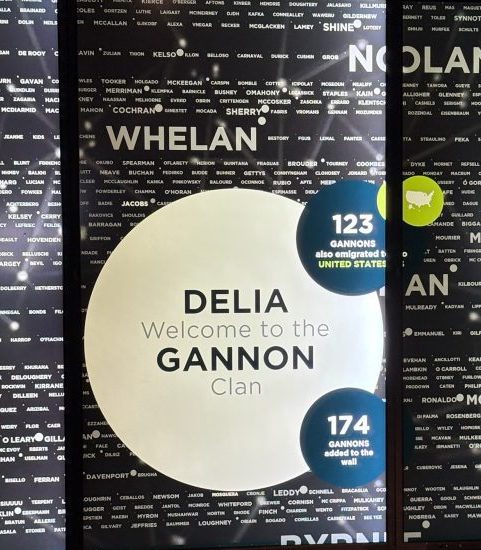
For me, when a museum evokes so many feelings as EPIC did, I know their curators have carefully pieced together the stories of the people it represents. Before I left, I entered my grandparents’ names to be shown on the museum’s digital Legacy Wall, a touching way to record that one of their loved ones made it back to their homeland.
Cobh Heritage Center
I’m not sure where my grandmother left from when she emigrated from Ireland, but I know my grandfather left from Queenstown, now Cobh. Being in the same place where he said goodbye to his homeland and never returned will stay with me for the rest of my life.
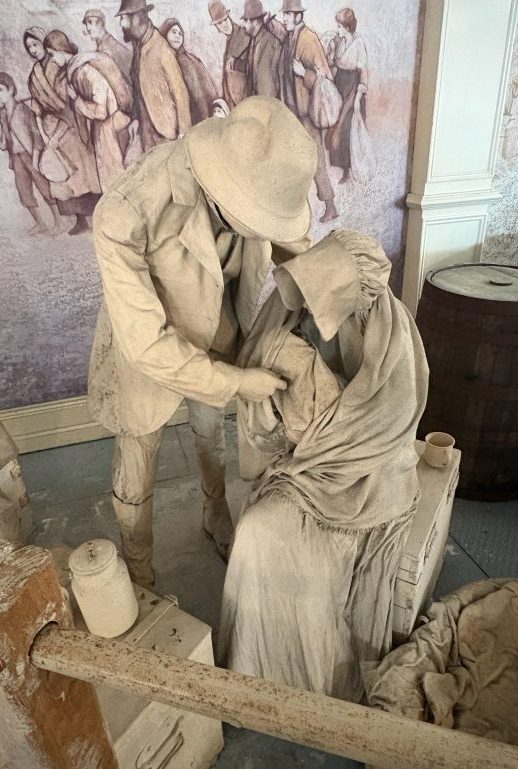
The Cobh Heritage Center lets visitors explore what was happening in Ireland as many left for Australia, Canada, and the United States; most of all, it delves into the conditions people faced on the ships and how sea travel improved over the years.
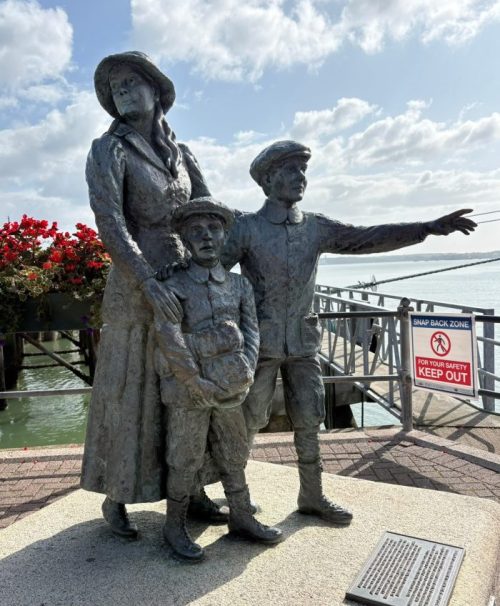
Each entry ticket has the name of a passenger featured in the museum. I received Annie Moore, whose story I had just learned about in Dublin. I thought this was an interesting idea as it keeps you even more engaged during the visit as you search for your person. A statue of Annie and her brothers pointing toward New York City by Irish artist Jeanne Rynhart stands outside the center. I learned there’s a companion sculpture of Annie, positioned to face toward Cobh and by the same artist, in the Ellis Island National Museum of Immigration in New York. I hope to check it out one day.
In addition to educating visitors about what people sacrificed to leave Ireland and the horrible conditions they found on ships, the museum also features exhibits from later years and improvements in ship quarters, which left me feeling uplifted because I thought to myself that maybe my grandparents’ trips to Ellis Island weren’t horrible.
The Cobh Heritage Center also features photos of the Titanic before it left Cobh—its last stop before heading to New York. Frank Browne, a theological student, took the pictures while traveling from Southampton, England, to Queenstown. An American couple offered to pay his remaining fare to the United States. However, he sent a telegram to his Jesuit Superior in Dublin, who replied that he should leave the ship. Because Browne listened to his superior, he lived a long life, and his photos still exist today, documenting activities such as passengers boarding the Titanic and enjoying its deck.
The center is conveniently located steps from the Cobh train station and where the cruise ships dock. Like EPIC, a visit to the Cobh Heritage Center was both educational and emotional. I recommend both museums to anyone who wants to learn more about Ireland’s history and its people. I know if the museums were in New York, I would be planning a trip with my relatives to visit them together. Maybe one day we can all travel to Ireland to see these two museums and more together.
As for Cobh, Dublin, and other parts of Ireland, I have so much more to say and plan to share more about my trip in future blog posts.


I am glad you got to experience Ireland. Finally. And wasn’t it nice to share that with your hubby?
LikeLike